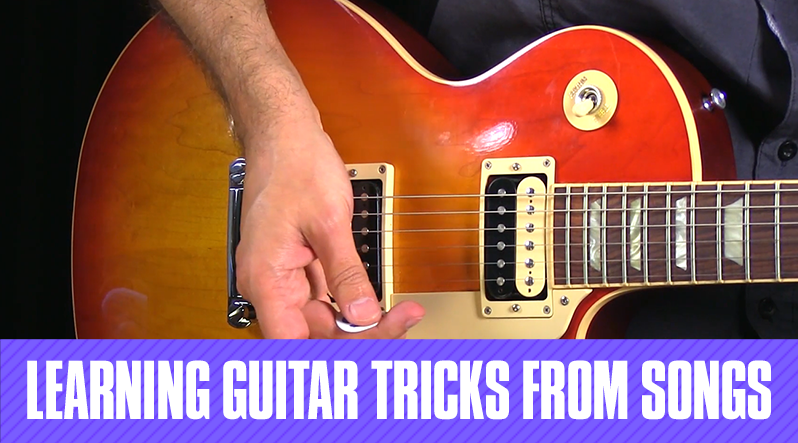
The guitar fretboard is a bit intimidating.
But once you understand a couple of key concepts, you'll be able to see patterns and shapes throughout the fretboard.
Going deeper, understanding exactly where some notes live will take your memorization to the next level.
From this article you'll learn the in's and out's of the fretboard so you can get better and learn how to play guitar.
You'll learn:
- The Parts Of The Guitar - how it all works including guitar string notes
- Fretboard layout - what it looks like
- Memorization tips - Low E and A string note names
- Wholistic fretboard understanding - patterns and techniques
What is the guitar fretboard?
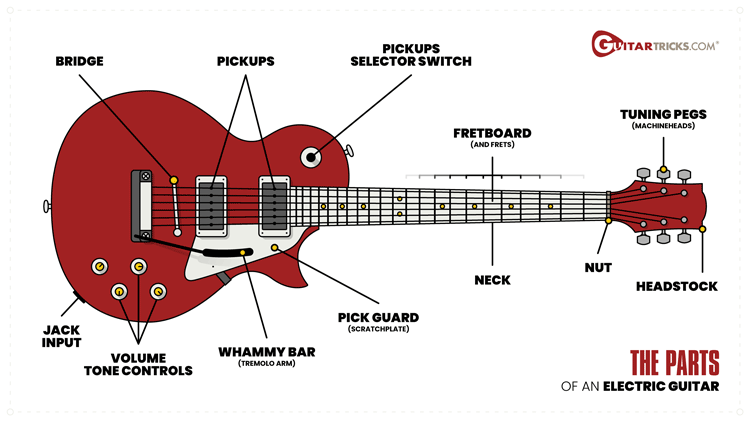
The guitar fretboard or fingerboard is the part of the guitar where all of the metal guitar frets are placed.
The fretboard is used by holding down the strings against each fret and then either picking or strumming some, or all of the strings.
The vibrating motion of the string against the metal frets create the sounds of different musical notes.
The fretboard of a modern guitar is made up of a number of pieces and it’s important for guitar players to know which piece is which, as well as learn ways to develop memorization of the fretboard notes.
The fretboard is usually a piece of wood that sticks out from the body of the guitar, and is also referred entirely as the “neck” of the guitar.
Memorizing the Fretboard

While shapes can be helpful, understanding where every note lives opens up far more creative freedom and confidence when navigating the neck.
One of the smartest starting points is to memorize the low E and A strings.
These two strings serve as the root for most barre chords and scale positions.
Because they repeat again once you reach the 12th fret, knowing them gives you a major head start.
What are the strings on a guitar?
Let's start with the open guitar string note names - E, A, D, G, B, E.
Leaning on simple tools like mnemonic devices can heal greatly when trying to commit this kind of info to memory.
A classic one for the open strings is “Eddie Ate Dynamite, Good Bye Eddie.”
You'll then need to start moving up the neck fret by fret - this is where understanding sharps and flats come into play.
Check out the fretboard note diagram above and let's stick with the low E string for now.
The musical alphabet isn't 26 letters, but 7 - A, B, C, D, E, F, G - this is the foundation of muscial notation, which applies directly to the fretboard.
Quick Music Theory: Most note names have a sharp (#) or flat (b) between them, save for two - B to C and E to F.
Working our way up the fretboard on the low E string you'll play a 12 note sequence to get you up one octave - F, F#, G, G#, A, A#, B, C, C#, D, D#, E.
A simple way to apply this to another string is take the sequence we just built and start from a different open string note.
So if we started on the low A string (the next string up from the low E string) the sequence would be - A, A#, B, C, C#, D, D#, E, F, F#, G, G#, A.
Make Chords, Make Music
So what does this mean for playing guitar and making music?
The most direct application is with barre chords.
Make a barre chord shape and move up the neck fret by fret in the same way you just did note by note.
On the low E string, make a barre chord on the 5th fret.
Checking our diagram and pattern, this will be an A chord.
Move up one fret, you are playing an A# chord.
Move up another, you're playing a B chord, and so on.
Now you know 12 chords - simple as that!
On the A string, instead of playing the barre chord shape, play the power chord shape up the fretboard.
Now you know 12 chords in 2 different voicings!
Fretboard Roadmap - Inlays
Walking up and down the fretboard is useful in learning how the fretboard is put together but isn't the most practical for playing songs.
This is where those dots on the fretboard come in - these dot inlays are visual markers for important frets.
Use those inlays at frets 3, 5, 7, 9, and 12— as anchor points.
These frets often correspond to familiar note groupings.
For example, you might notice that the 3rd, 5th, and 7th frets on a string often outline the major scale, such as G-A-B or C-D-E.
Recognizing these patterns and clusters helps connect your visual memory with note names.
The most common inlays are dots, but you'll also see rectangles, triangles, and sometimes more artistic shapes like birds!
Octave Shapes
Another great way to memorize the fretboard is through octave shapes.
An octave is when the same note occurs again at a higher pitch.
This was outlined in the chromatic pattern we built earlier in this article.
From the open string, playing the same string at the 12th fret will give you the next ocatve up.
You can learn all of the locations of these octaves throughout the fretboard, which will help you understand further how the fretboard is layed out.
There are some patterns that show you how the same note appears in multiple locations across the neck.
For instance, if you play a note on the low E string, you can find its octave two frets up and two strings down.
So if i you play fret 1 on the low E string, you'll find that octave on fret 3 of the D string.
Learning these visual cues and patterns will help you navigate horizontally and vertically!
This will provide a wholistic understanding of the fretboard.
The fretboard is a whole system, not just a clumping of different position patterns.
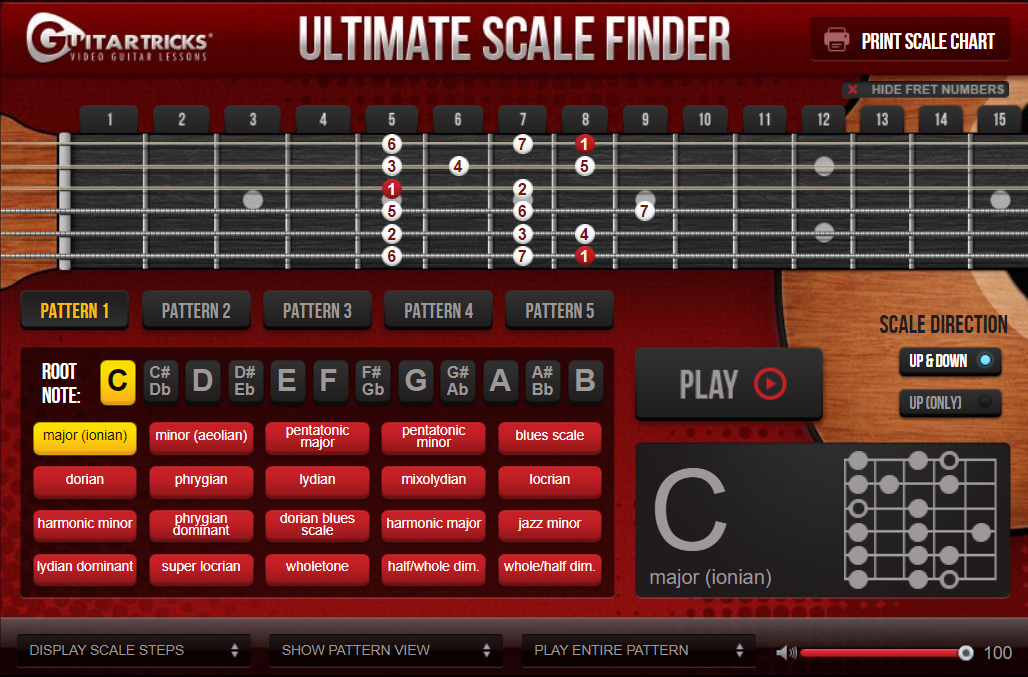 Another great way to learn the fretboard is to practice your guitar scales with the Guitar Tricks Scale Finder
Guitar Fretboard Maintenance
Knowing all of these patterns and techniques is great.
But there are other aspects of the fretboard that should not be overlooked.
Namely setup and maintenance.
If your fretboard isn't set up properly, the whole guitar can be out of tune!
Follow along with the guitar parts diagram above.
Dividing the guitar fretboard with the headstock is the nut.
The guitar nut is the piece of the guitar where the strings run through to get to the headstock.
The nut of the guitar is a vital piece of the hardware since it holds each string in place and can affect the tuning and playability of a guitar.
A nut that is too small or too big in its cavity can result in a guitar that can feel difficult to press down - high action.
A nut that is too deep can result in the strings being too low and that will cause rattling.
A poor nut can contribute guitar tuning issues, strings fretting out or the aforementioned string buzz.
What about the frets themselves?
The frets are metal strips that are slotted into the wooden part of the board.
You press the strings down onto the fretboard between these frets to make musical notes or guitar chords.
The distance between one fret to the next will get smaller as you go up the fretboard.
This is because the length of the vibrating string is getting shorter moving toward the body of the guitar.
(A three foot piece of vibrating steel string will sound lower than a 1 foot piece of vibrating string).
Fretboard materials can vary as well.
The fretboard itself is usually a separate thin piece of wood that sits on top of the neck wood.
Popular wood combinations are a neck made of maple, and a fingerboard made of rosewood.
But it’s also common for the entire neck and fingerboard to be one piece of wood.
This is all great information if you ever plan to build a parts guitar.
FAQ
How do you memorize notes on a fretboard?
Memorizing notes on the fretboard can be done by breaking it down into smaller sections, like focusing on one string at a time, and using mnemonic devices or patterns. Regular practice and visual aids, like fretboard diagrams, can also help reinforce your memory.
What are the notes on a guitar fretboard?
The notes on a guitar fretboard repeat every 12 frets and include all the natural notes (A, B, C, D, E, F, G) and their sharps/flats. Each string starts with a different note, with the low E string starting at E, and so on.
How to tell what fret a note is on?
To tell what fret a note is on, you can use the musical alphabet and count up from the open string, remembering that each fret represents a half step. Learning the notes on the open strings and the fifth and seventh frets as reference points can make this easier.
How to read guitar notes for beginners?
Reading guitar notes for beginners involves understanding standard notation and tablature (tabs). Tabs show the strings and frets to play, while standard notation indicates pitch and rhythm. Starting with simple melodies and practicing regularly helps in getting comfortable with both.
How can I learn guitar notes easily?
Learning guitar notes easily can be done by practicing scales and simple songs, using fretboard diagrams, and focusing on one string or one section of the fretboard at a time. Consistent practice and using mnemonic devices to remember note positions also help.
What should be the first chords to learn on guitar?
The first chords to learn on guitar are usually the open chords like G, C, D, E, Em, A, and Am. These chords are easy to play and are the building blocks for many songs.
What is the easiest way to memorize guitar chords?
The easiest way to memorize guitar chords is through regular practice and repetition. Playing songs that use the chords you are learning helps, as does visualizing the chord shapes and practicing chord transitions.
What is the hardest beginner chord on the guitar?
The hardest beginner chord on the guitar is often considered to be the F major chord. It requires a barre technique that can be challenging for new players to master.
What is the easiest guitar chord to play for beginners?
The easiest guitar chord to play for beginners is typically the E minor (Em) chord. It only requires two fingers and is easy to switch to and from other chords.
What is the easiest genre of guitar to learn?
The easiest genre of guitar to learn is often considered to be folk or pop music. These genres frequently use simple chord progressions and strumming patterns that are beginner-friendly.
Get More Tips